Every day, our minds buzz with a continuous stream of thoughts that influence how we feel and act. Recognizing whether these thoughts are healthy, unhealthy, or harmful can significantly impact our mental health and overall well-being. This guide will help you identify different types of thought patterns and provide strategies to cultivate a more positive mental landscape.
Healthy Thought Patterns What Are They? Healthy thought patterns are adaptive and constructive. They promote resilience and flexibility, helping you respond to life’s challenges with strength and clarity.
Characteristics:
- Flexibility: Adapts easily to change.
- Resilience: Quickly recovers from setbacks.
- Growth-Oriented: Focuses on personal development.
Examples:
- “I can learn from my mistakes.”
- “Challenges help me grow.”
- “I deserve to be happy.”
Benefits: Engaging in healthy thought patterns enhances life satisfaction, improves relationships, and boosts your ability to achieve personal goals.
Unhealthy Thought Patterns What Are They? Unhealthy thought patterns can distort reality and create needless emotional distress. They often manifest as rigid, pessimistic views that are not based on factual evidence.
Characteristics:
- Pessimistic: Sees the negative side of every situation.
- Rigid: Unable to see alternative solutions.
- Short-sighted: Focuses only on immediate relief, ignoring long-term consequences.
Examples:
- “I must be perfect or I’m a failure.”
- “Nobody understands me.”
- “Things will never get better.”
Consequences: Such thoughts can lead to stress, depression, and anxiety, making it difficult to cope with everyday situations.
Harmful Thought Patterns What Are They? Harmful thought patterns are intensely negative and destructive. They can degrade one’s quality of life and may lead to serious mental health issues.
Characteristics:
- Self-destructive: Encourages behaviors or thoughts that are damaging.
- Delusional: Holds onto beliefs that are clearly contradicted by reality.
- Despairing: Filled with hopelessness and helplessness.
Examples:
- “I am worthless.”
- “I can’t change anything in my life.”
- “No one cares about me.”
Risks: These thoughts can impair social functions, lead to isolation, or worse, provoke self-harm or extreme negative actions.
Changing Your Thought Patterns Self-Assessment Tips: Regularly monitor your thoughts to identify patterns. Reflect on how they make you feel and how they influence your behavior.
Change Strategies:
- Cognitive-behavioral techniques: Learn to challenge and replace negative thoughts with more positive, realistic ones.
- Mindfulness: Practice staying present and non-judgmental to reduce the impact of negative thoughts.
- Professional Guidance: Don’t hesitate to seek help from a therapist if your thoughts are causing significant distress.
Understanding and managing your thought patterns is a crucial skill for maintaining mental health and achieving life satisfaction. By learning to identify and modify your cognitive behaviors, you can enhance your emotional resilience and lead a more fulfilling life.
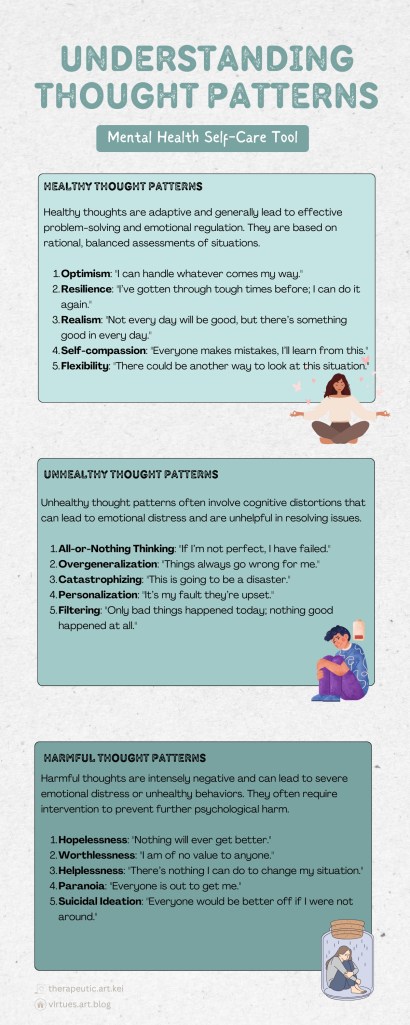
Below is a downloadable PDF mental health self-care tool that can help you self-assess the health of your thought patterns. This resource is designed to assist you in taking proactive steps to nurture, protect, and fortify your mental health.
Disclaimer: I am not a clinical therapist. The content provided in this mental health self-care tool is intended for educational purposes only and should not be considered a substitute for professional mental health services.
 Virtues & Art
Leave a comment